
5 May 2026|AI Engineering
AI-Augmented Engineering: Amnesia, Invented APIs and Team Knowledge Silos
Three practical AI engineering failure modes, with checks for session continuity, real API contracts and shared team knowledge.
Discoveries and developments from across the industry that support our engineering work: sovereign AI, agent grounding, compliance architecture and data strategy.
For our own build work, see Engineering →
Three practical AI engineering failure modes, with checks for session continuity, real API contracts and shared team knowledge.

How to turn team chat into traceable knowledge, with structured summaries, source links, permission checks and tests for stale answers.

Use architecture decision records to give agents the reasoning behind a choice, with explicit approval, source links and searchable supersession.

Put a knowledge cache in front of team records without losing source ownership, access controls or a way to check freshness.

Record engineering gotchas with symptoms, evidence and tested fixes so people and agents can check past failures before repeating the investigation.

Check stored claims, answer citations and uncited statements separately, with traceable evidence and explicit limits on what verification proves.

Time weighting can demote older retrieval results, but current answers also need valid timestamps, supersession and tests.

Turn-by-turn capture needs a verified save boundary, replay-safe retries and summaries that point back to the original conversation.

Build a repo matrix from traceable code evidence, keep it current and make agents check existing contracts before proposing changes.

Expose team AI memory through MCP tools with clear schemas, source references and separate write permissions, without replacing your existing API.

Compare extraction pipelines by accepted records, validation failures and retry costs before choosing a smaller model for speed.

Evaluate AI inference hardware at realistic concurrency, with throughput, latency and output quality measured together.

Assess local AI hardware through model fit, useful capacity, data boundaries and ownership costs before committing a £4,000 budget.

Route LLM workloads by required quality, response time and failure cost, with tested escalation rather than assumptions about model size.

Reasoning effort changes how gpt-oss approaches a task. Test output budgets and accepted records before claiming a throughput gain.

Evaluate an AI product through answer provenance, failure handling and data location, with evidence to request before procurement.

Design offline compliance records with explicit save states, traceable corrections and tested server acceptance, rather than a single sync indicator.

The challenge of managing field operations often involves fragmented data and disconnected systems. Operational Directors and CTOs grapple with the problem of

Local inference changes where processing happens. Protected records, access controls and tested audit trails establish what happened to the data.

Automated compliance workflows need versioned rules, accountable approvals and retrievable evidence. AI should assist within those controls.

Design mobile safety audits around evidence, corrective actions and review, while keeping England's building safety golden thread duties in scope.

Design API contracts around traceable field records, explicit save outcomes and tested recovery, rather than promises of automatic data continuity.

Offline GDPR compliance needs explicit retention rules, deletion acknowledgements and tests that stop old devices restoring erased records.

Plan SQL to NoSQL migration around record meaning, repeatable change capture and tested rollback, rather than a promise of greater scale.

Assess React Native and Capacitor through record identity, correction history and evidence handover, rather than promises of automatic compliance.

Serverless logging needs bounded concurrency, safe retries and tested recovery. Automatic scaling alone does not prove data continuity.

Measure battery use against real field tasks, then tune location, transfers and background work without hiding delays or weakening records.

Real-time collaboration needs explicit conflict rules, clear save states and protected history so shared field records remain traceable.

Compare React Native and Capacitor through local storage, native integrations and recovery tests, rather than promises about data continuity.

Use geofencing for asset tracking without confusing a device alert with continuous location evidence or proof of building safety compliance.

Design field app user experience around clear labels, accessible errors and truthful save status, with ownership and recovery tested before release.

Biometric authentication can support field accountability, but permissions, protected logs and offline rules must establish what happened.

Microservices can separate field workloads, but traceable records depend on service boundaries, safe retries and explicit ownership.

Use vector search to find related field records offline, while keeping original observations, permissions and synchronisation separate.

Separate screen state from saved records when choosing Redux or MobX for offline-first field apps, with explicit recovery and synchronisation rules.

Choose cross-platform UI frameworks around a shared data contract, with explicit record meanings, portable exports and tested upgrade behaviour.

Test offline apps through interrupted saves, lost responses and conflicting edits, with evidence that records survive and synchronise correctly.

Test operational AI against expert judgement and simple rules, with traceable data, explicit limits and evidence from the work it supports.

Make field predictions useful offline: validate inputs, test the data held on the device and measure the decision rather than model accuracy alone.

Design scalable data architecture around measured demand, queue recovery and database behaviour, rather than assuming more services will solve capacity.

Hidden buttons and obscure URLs do not enforce permissions. Put access checks on the server and test what each user must be refused.

Design actionable business intelligence around decisions, named owners and reliable data, with alerts reserved for work that needs a response.

Compare cross-platform app development cost through shared code, native integration, testing and upgrades, rather than assumed savings.

Use digital twins for building safety decisions with traceable records, tested models and explicit limits on prediction and automated action.

How to design offline decision trees with explicit rules, local inputs, versioned policies and safe synchronisation when connections return.

Treat database normalisation as a question of record meaning, enforceable relationships and correction work, rather than a guarantee of clean data.

Use protected event histories to investigate incidents, test causal explanations and choose leading indicators without promising predictive safety.
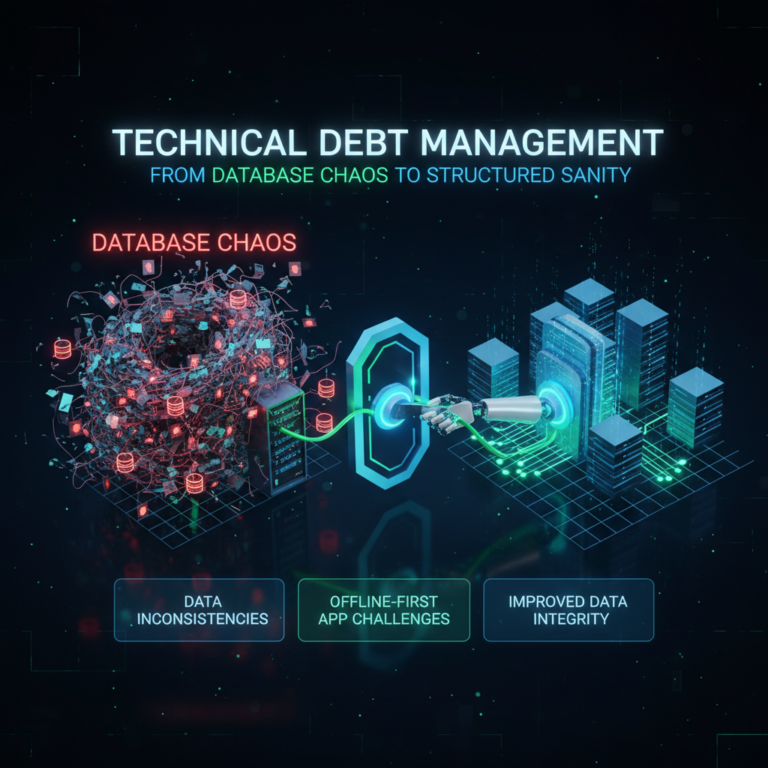
Manage technical debt in offline field apps with explicit data rules, tested conflict handling and staged migrations, rather than a wholesale rewrite.

Federated learning keeps raw training data on devices, but private mobile LLM training still needs leakage controls and a measured deployment plan.

Size field service systems for queued work, reconnect bursts and conflicting updates, rather than relying on registered user counts.

Measure local LLM inference latency against the field task, then test model compression, native integration and offline behaviour on real devices.

Build a single source of truth around data ownership, explicit API contracts and tested rules for stale copies and conflicting changes.

Define useful data quality rules, find errors at source and keep corrections traceable across business systems and offline field apps.

Modernise field workflows by testing offline work and API boundaries, rather than assuming a mobile wrapper fixes a legacy application.

Construction data architecture needs clear ownership, revision control and tested handovers, including what happens when site devices work offline.

Offline-first field apps need clear rules for local saves, retries and conflicting edits. Define what each action means before choosing the tools.

Database normalisation reduces duplication, but savings need evidence. Separate data integrity from query performance before changing your cloud database.

Secure offline mobile data with explicit access rules, protected local storage and evidence that controls work when devices lose connectivity.

Cloud cost optimisation starts with ownership and measured demand. Use allocation, scaling and budget controls without promising automatic savings.
Nothing matches that yet. Try another word or topic.