Taming the Cloud: Database Normalisation for Cost-Effective Infrastructure
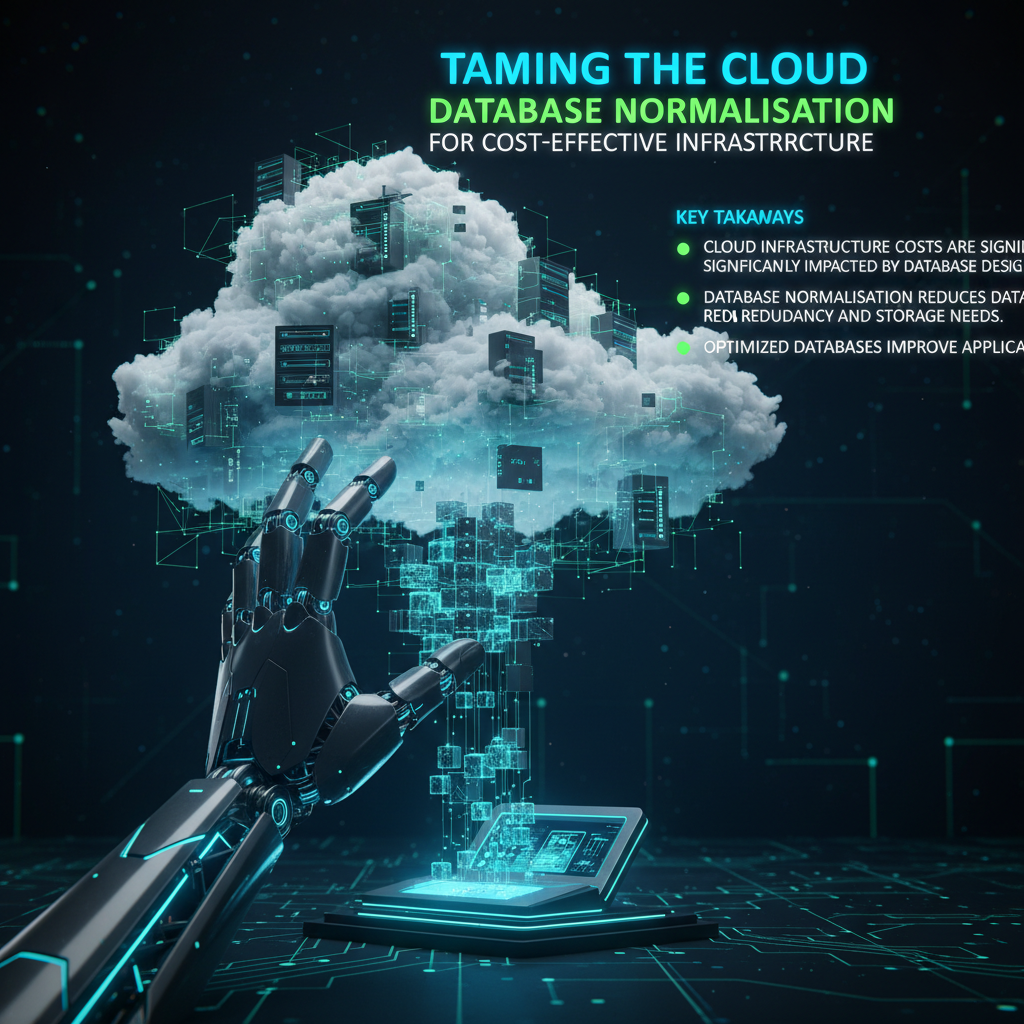
Key Takeaways
- Cloud infrastructure costs are significantly impacted by database design.
- Database normalisation reduces data redundancy and storage needs.
- Optimised databases improve application performance and scalability.
- Well-structured data facilitates better reporting and decision-making.
- Legacy systems often contain un-normalised data, leading to increased cloud costs.
The Cloud Cost Conundrum
Cloud infrastructure is the backbone of modern enterprise, promising scalability and efficiency. However, many organisations find their cloud costs spiralling out of control. A key culprit often lies hidden beneath the surface: poorly structured data. Un-normalised databases consume excessive storage, slow down applications, and complicate data analysis, directly impacting your bottom line.
What is Database Normalisation?
Imagine your data as a messy toolbox, filled with duplicate tools scattered everywhere. Database normalisation is the process of organising that toolbox. It’s a systematic approach to structuring your database to minimise redundancy and improve data integrity. This process involves dividing your data into tables and defining relationships between them.
The Normal Forms
Normalisation follows a series of ‘normal forms’, each building upon the previous one. Think of it like levelling up in a game. First Normal Form (1NF) eliminates repeating groups of data. Second Normal Form (2NF) ensures that non-key attributes depend on the entire primary key. Third Normal Form (3NF) removes transitive dependencies, meaning that non-key attributes shouldn’t depend on other non-key attributes. While there are higher normal forms, 3NF typically provides a good balance between data integrity and complexity for most business applications.
The Cost Benefits of Normalisation
The primary benefit of database normalisation is reduced data redundancy. Storing the same information multiple times wastes storage space and increases costs. By eliminating duplication, you can significantly reduce your cloud storage footprint. Furthermore, smaller databases are faster to query and process, leading to improved application performance and reduced compute costs. Data consistency is also improved, preventing costly errors caused by contradictory information.
Performance Gains
Normalised databases are not only cheaper, but they are also faster. Consider a scenario where you need to update a customer’s address. In a non-normalised database, you might have to update multiple records across different tables. In a normalised database, you only update one record in the customer table. This simplifies data maintenance and reduces the risk of inconsistencies. Improved performance translates directly into lower cloud compute costs, as your servers spend less time processing data.
Legacy Systems: A Breeding Ground for Data Chaos
Many organisations are running legacy systems that were designed without modern cloud infrastructure in mind. These systems often contain un-normalised data, a relic of a bygone era. Migrating this data to the cloud without proper normalisation is akin to moving a chaotic attic into a brand new house. The problems simply get amplified. Retrofitting normalisation on legacy databases can be challenging, but the long-term cost savings and performance improvements are well worth the effort.
Migrating to a Normalised Structure
The migration process often involves data profiling, schema redesign, and data transformation. Data profiling helps you understand the current state of your data and identify areas for improvement. Schema redesign involves creating a new database schema based on normalisation principles. Data transformation involves cleaning, transforming, and loading your data into the new schema. This process can be complex and requires careful planning and execution.
Dendro Logic Perspective
At Dendro Logic, we view data as the lifeblood of your organisation. A well-structured database is like a healthy circulatory system, ensuring that information flows smoothly and efficiently. Normalisation is not just a technical exercise, it is a strategic investment that can significantly improve your cloud infrastructure costs. We specialise in taking these chaotic, unloved legacies and converting them into structures that perform efficiently and accurately.
Ready to tame your cloud costs and optimise your data infrastructure? Contact us today to audit your database architecture.